Beyond Connectivity: Why Hospitality Could Become a New Revenue Opportunity for Telecom Operators
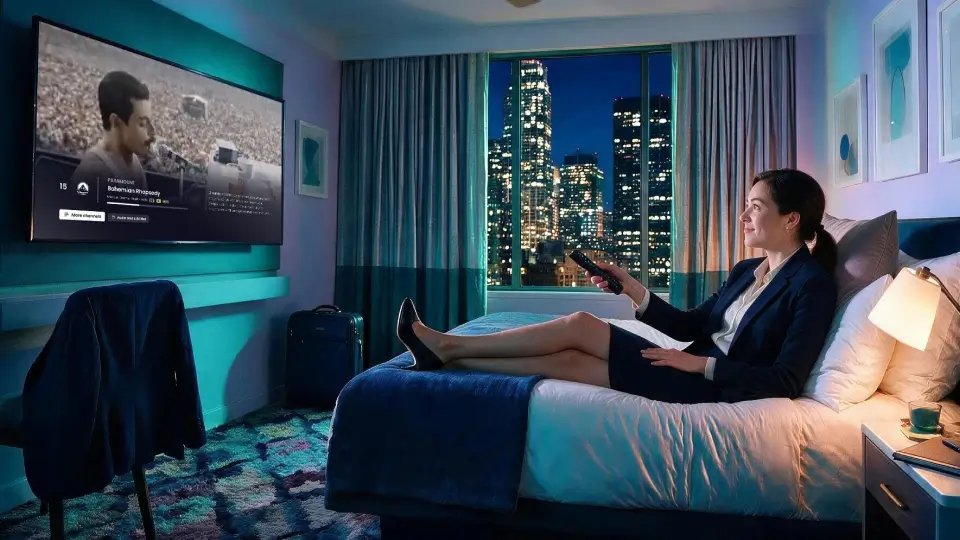
- Sep 29, 2026
For decades, telco operators have built their businesses around connectivity. Broadband, mobile networks and communications services have provided the foundation for an industry that has transformed how consumers, businesses and entire economies operate. Yet as connectivity markets mature, operators are increasingly looking beyond the network itself to identify new sources of value and new ways of strengthening their relationships with customers.
The shift is already underway. According to GSMA Intelligence, services beyond traditional core telecoms accounted for 28% of major operators’ total revenues in 2024, compared with 18% in 2017. The research reflects a broader transformation across the industry, as operators look to diversify their businesses and generate additional value from the infrastructure, capabilities and customer relationships they have built over decades.
For many operators, this means moving further into managed services, cloud, security, IoT and other technology services. Video also has an important role to play, particularly in B2B markets where operators can leverage their existing connectivity relationships to address new customer needs.
Hospitality is one of the clearest examples.
Hotels are already highly dependent on telecommunications infrastructure. Reliable connectivity, WiFi, networking and digital services are essential to their daily operations and increasingly important to the guest experience. At the same time, expectations around in room entertainment are changing rapidly, creating an opportunity for operators to extend their role from connectivity provider to broader technology and video partner.
The opportunity is not simply about putting television into hotel rooms. It is about understanding how the role of television is changing, why hotels are investing in richer digital experiences and how telcos can participate in that transformation without creating an entirely new layer of operational complexity.
The hotel room is becoming a connected environment
The expectations of hotel guests have changed significantly as streaming and connected entertainment have become part of everyday life. Travelers increasingly arrive at a hotel with the same services, subscriptions and devices they use at home, and they naturally expect the technology in their hotel room to accommodate those habits.
This is changing the role of the television. Guests are no longer necessarily satisfied with a traditional channel lineup. They increasingly expect access to streaming services, casting, personalized content, intuitive interfaces and the ability to connect their own devices to the screen.
Research from J.D. Power illustrates just how quickly this expectation has developed. Its 2025 North America Hotel Guest Satisfaction Index found that 40% of hotel guests considered a smart TV or the ability to stream their own entertainment a “need to have,” compared with 21% in 2019. The same research found that approximately 60% of guests used the smart TV during their stay.
Other research points to similar behavior. Hilton’s 2024 trends research found that 80% of global travelers considered the ability to use their personal devices seamlessly with on property technology, including WiFi and streaming applications, important. At Hilton properties offering its Connected Room experience in the United States, 80% of guests watched video content, while those guests who streamed spent approximately five hours streaming during their stay.
More recent data also suggests that casting is becoming an increasingly important part of the hotel entertainment experience. Research published in 2026 based on more than 8,500 rooms across 36 hotels in the United States and Europe found that more than 30% of hotel guests used casting during their stay, with users averaging approximately three casting sessions and 224 minutes of viewing.
These figures point toward a fundamental change in what guests expect from hotel entertainment. The benchmark is no longer simply another hotel. It is the digital experience that travelers are accustomed to in their own homes.
That puts pressure on hotel operators to modernize their in room entertainment environments, but it also creates an opportunity for the telecommunications industry.
A large and growing B2B market
The potential becomes particularly interesting when the scale of the hospitality industry is considered.
The global hotel market represents millions of rooms that require connectivity, technology and ongoing operational support. IHG’s 2025 annual report estimates global hotel room supply at approximately 23.7 million rooms, compared with around 20.1 million in 2021. At the same time, the global hotel development pipeline continues to expand, with more than 1.7 million rooms reported to be under construction, in final planning or in planning across the major markets tracked by CoStar in 2025.
This represents a substantial addressable environment for technology providers, but the opportunity for telecom operators is particularly relevant because many of the underlying requirements are already part of their existing business relationships.
Hotels need reliable broadband and WiFi. They need networking infrastructure, security and managed services. They need technical support and monitoring. Increasingly, they also need the technology required to deliver a sophisticated digital entertainment experience across hundreds or thousands of rooms.
For an operator that already provides connectivity to a hotel group, adding managed TV and video services can therefore represent a logical extension of an existing relationship rather than an entirely new market entry strategy.
The commercial proposition is also potentially attractive because TV is not limited to the initial deployment. A managed TV service can encompass content distribution, applications, device management, content protection, monitoring, support and ongoing platform development, creating an opportunity for recurring B2B service revenue rather than a one time hardware transaction.
The more properties a hotel group operates, the more relevant that model becomes. A platform that can be deployed and managed consistently across multiple properties can give operators the opportunity to build a service that scales alongside their hospitality customers.
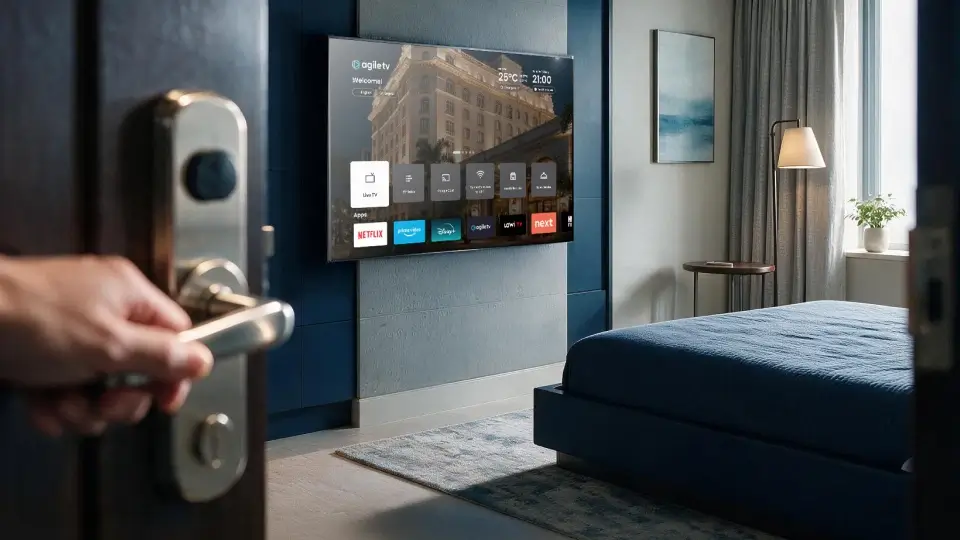
From hotel television to digital guest experience
The opportunity becomes even more significant when TV is considered as part of the wider digital guest experience rather than as a standalone entertainment service.
The screen in a hotel room can increasingly act as a gateway to a broader range of digital services. In addition to live television and streaming, it can provide hotel information, personalized recommendations, local content and other services relevant to the guest’s stay. When integrated with mobile applications and other hotel technology, the TV can become another touchpoint through which guests interact with the property.
Hotel groups are already exploring this direction.
Hilton has continued to expand its Connected Room strategy, which allows guests to interact with connected room technology and personalize elements of their entertainment experience. In 2025, Hilton reported that the number of digitally connected rooms across its global portfolio had increased by 53% in one year, while 5.1 million Hilton guests were using premium entertainment and wellness streaming applications each month.
This development illustrates why hotel TV should not necessarily be viewed as a declining legacy service that is being replaced by streaming. Instead, the television is becoming one of the interfaces through which streaming, personalization and connected services are delivered.
For hotels, this can contribute to a more modern and consistent guest experience. For telecom operators, it creates a broader service opportunity around the connectivity infrastructure they already provide.
The opportunity for telcos
For telecom operators, hospitality brings together several elements that make the market particularly relevant to their diversification strategies.
The first is the existing customer relationship. Many hotels already depend on telecom operators for connectivity and networking services, meaning that operators have an established commercial and technical relationship from which they can build.
The second is the recurring nature of the service. A fully managed TV proposition can extend well beyond the initial installation, incorporating content delivery, platform operations, applications, monitoring, device management and ongoing support.
The third is the potential to deepen the relationship with hotel groups. Providing multiple technology services can make an operator a more important technology partner, particularly when those services are managed through a common operational environment.
Finally, there is the opportunity to leverage capabilities that telecom operators already possess. Network operations, cloud infrastructure, security, service management, monitoring and 24/7 support are all familiar areas for the industry. Extending those capabilities into managed TV and video is therefore less about building an entirely new business and more about applying existing strengths to an adjacent market.
The challenge, however, is ensuring that the additional revenue opportunity does not come with an equivalent increase in operational complexity.
👉 Ready to explore new B2B revenue opportunities in hospitality?
Discover how AgileTV helps telcos bring TV services to hotels and other hospitality venues, opening up new business opportunities beyond residential connectivity.
The complexity behind the experience
Delivering TV to a hotel is considerably more complex than simply installing a television and providing a channel lineup.
A hotel group may have hundreds of rooms across multiple properties, each with different requirements. It may need a combination of live channels, on demand content, streaming applications and casting capabilities, together with branded interfaces, multilingual experiences and integrations with existing hotel systems.
Behind that experience sits a considerable technology environment involving content ingestion, encoding, content protection, applications, device management, distribution, CDN services, monitoring and support.
Managing those components independently can quickly create a fragmented technology environment. For a telecom operator entering the hospitality market, building a separate operational model around every new service can make it difficult to achieve the scale required to make the proposition commercially attractive.
This is where the technology architecture becomes important.
Rather than treating hospitality TV as a collection of separate systems, operators can use a unified technology and operational layer that brings the different components together. This allows the operator to focus on the customer relationship and commercial proposition while the underlying platform handles the complexity required to deliver the service.
The objective is not to eliminate complexity from the technology itself. Modern TV services are inherently complex. The objective is to ensure that complexity is absorbed by the platform rather than passed on to the operator or the hotel.
Making hospitality TV scalable
This is where managed TV platforms can play an important role in helping telecom operators enter the hospitality market.
At AgileTV, the approach is centered on giving operators the technology and operational capabilities required to offer TV services to hospitality customers without requiring them to build a completely new TV organization internally.
A cloud native, end to end platform can bring together TV delivery, applications, device management, content protection, CDN orchestration, monitoring and operational support within a common environment. Professional services can then support migrations, deployments and ongoing lifecycle management, while managed operations provide the day to day expertise required to keep the service running.
For telecom operators, this model can provide a foundation for developing their own hospitality propositions while maintaining their existing commercial relationships with customers.
For hotels, the result can be a more modern in room entertainment experience that reflects the way guests already consume content at home, while giving hotel groups a technology environment that can be managed consistently across properties.
The commercial opportunity therefore extends beyond television itself. It is about enabling operators to build a broader managed digital service around the hotel room and, in doing so, create another source of recurring B2B revenue.
A new layer of value for telecom
The wider lesson from hospitality is that the future of telecom is not necessarily about moving away from connectivity. It is about finding new ways to build value around it.
Hotels already rely on telecom operators for the infrastructure that keeps their businesses connected. As the guest experience becomes increasingly digital, there is an opportunity to extend that relationship into the services that run on top of the network.
TV and video are particularly relevant because they sit directly at the intersection of connectivity, entertainment and digital experience. The technology is becoming more sophisticated, guest expectations are increasing and hotel groups are looking for solutions that can be deployed consistently across increasingly connected properties.
For telecom operators, hospitality therefore represents more than another vertical market. It provides an opportunity to use existing infrastructure, expertise and customer relationships to develop a new managed service while strengthening their position as technology partners to the businesses they already serve.
The opportunity will ultimately depend on execution. Operators need solutions that can support sophisticated guest experiences without forcing them to build increasingly complex internal technology and operational environments. A unified TV platform can help address that challenge by bringing the technology and operational layers together, allowing operators to focus on the commercial opportunity while the complexity is managed behind the scenes.
And hospitality may only be one part of the opportunity.
The same shift toward connected, personalized and professionally managed video experiences is taking place in another environment with very different requirements and an equally important role for technology: healthcare.
Hospitals are becoming increasingly digital environments, and video is moving beyond entertainment to support communication, information and patient engagement.
That opens another chapter in the story of how telecom operators can take their video capabilities beyond the traditional consumer market.
And that is where the conversation about TV, connectivity and new B2B revenue opportunities continues.


