The shift from connectivity to experience
For years, telcos and ISPs have competed primarily on connectivity. Faster speeds, wider coverage and competitive pricing defined the battlefield. That model is now reaching its limits.
As broadband becomes increasingly commoditized, differentiation is harder to sustain. In this context, video services have re-emerged as a strategic lever. Not as a legacy add-on, but as a core component of the digital household.
The numbers reflect this shift. The global OTT market is projected to grow from $97.5 billion in 2026 to over $262 billion by 2034, with a steady CAGR of more than 13%. At the same time, the broader IPTV and OTT ecosystem is expected to reach $340 billion in 2026, driven by the convergence of linear TV and streaming models.
For operators, the opportunity is clear. The challenge lies in how to capture it efficiently.
Why TV is key for telcos and ISPs
Despite repeated predictions of its decline, TV continues to play a central role in telecom strategies. Its value is no longer limited to content distribution. It is now deeply tied to customer retention, service bundling and long-term revenue stability.
Industry analysis consistently shows that TV services act as a powerful anchor within bundled offerings, helping reduce churn and increase customer lifetime value. This effect becomes even stronger when multiple services are integrated into a single proposition.
In parallel, consumer expectations have evolved. Users now demand seamless, multi-device experiences, instant access to content, and a unified interface that blends live and on-demand viewing. Delivering this level of service is no longer optional.
Operators are responding accordingly. In Asia-Pacific alone, OTT partnerships between telcos and content providers have surpassed 500 agreements, growing over 12% year-on-year. This reflects a broader global trend: telcos are repositioning themselves as entertainment aggregators rather than pure connectivity providers.
The challenge of building TV from scratch
While the strategic rationale is strong, execution remains complex.
Launching a modern OTT or TV service is not simply a matter of deploying a video player. It requires a fully integrated ecosystem that includes content management, encoding, DRM, multi-device applications, billing systems, analytics, and continuous platform maintenance.
The financial implications are significant. Infrastructure investments, development resources, content preparation, and operational overhead can quickly escalate. For many operators, especially those outside Tier 1 markets, this creates a structural barrier.
Operational challenges add another layer. ISPs face increasing pressure on margins, with reports indicating that outdated or inflexible OTT infrastructures can lead to substantial revenue losses and inefficiencies. At the same time, piracy, churn, and evolving user expectations continue to erode profitability.
In this context, the traditional “build everything in-house” model is becoming harder to justify.
The rise of white-label and TVaaS ecosystems
To address these challenges, a growing number of telcos and ISPs are turning to pre-integrated, white-label TV platforms.
This model fundamentally changes the economics of launching a TV service.
Instead of high upfront capital expenditure, operators can adopt a more flexible, pay-as-you-grow approach. This reduces financial risk while enabling faster deployment. Cloud-based white-label platforms, already adopted by operators such as A1 Group, demonstrate how low-CAPEX models can make premium TV services accessible to a wider range of providers.
Beyond cost, the operational advantages are equally compelling.
Pre-built ecosystems provide immediate access to a mature technology stack, eliminating the need for lengthy development cycles. Time to market is dramatically reduced, allowing operators to respond quickly to competitive pressures and evolving consumer demand.
Expertise is another critical factor. Video delivery at scale requires specialized knowledge across multiple domains, from content workflows to streaming optimization and security. Partnering with an experienced provider effectively externalizes this complexity.
Cost savings as a strategic driver
The financial case for TVaaS becomes clearer when considering the full lifecycle of a TV service.
First, there is the reduction in initial investment. By avoiding the need to build infrastructure and applications from scratch, operators significantly lower their entry costs.
Second, operational efficiency improves. Maintenance, updates, and platform evolution are handled by the service provider, reducing internal resource requirements and ongoing expenses.
Third, faster time to market translates directly into earlier revenue generation. In a competitive landscape, launching months earlier can have a meaningful impact on subscriber acquisition and market positioning.
Finally, bundled and aggregated services have been shown to reduce churn by up to 20–50% compared to standalone offerings. This has a direct effect on profitability, as retaining customers is significantly more cost-effective than acquiring new ones.
Taken together, these factors transform TVaaS from a technical solution into a financial optimization strategy.
AgileTV and the shift from platform to fully managed ecosystem
As the market matures, the expectation is no longer just to launch a TV service, but to operate a complete entertainment ecosystem.
This includes seamless content aggregation, multi-device distribution, advanced monetization models, personalization capabilities, and robust security frameworks. It also requires continuous optimization to maintain performance, reliability, and user satisfaction over time.
For telcos and ISPs, assembling and operating this ecosystem independently is increasingly impractical. The complexity is high, and the operational overhead quickly translates into rising costs.
This is where fully managed TVaaS platforms make a tangible difference.
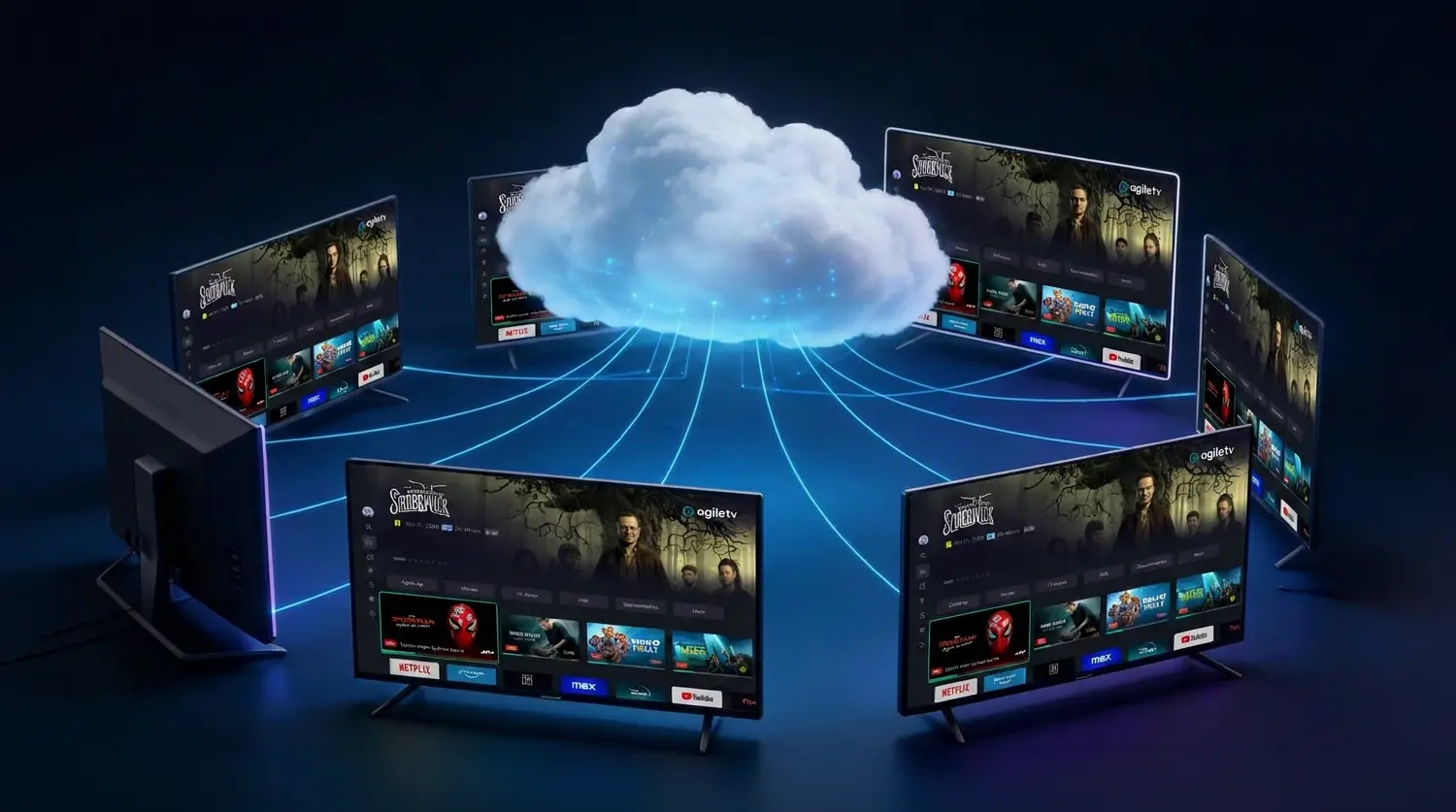
AgileTV’s TVaaS offering provides an end-to-end environment that covers the entire video value chain, from content ingestion and processing to distribution, monetization, and user experience. Everything is delivered as a unified, pre-integrated service, removing the need to stitch together multiple vendors or maintain fragmented systems.
A key component of this model is operational excellence. With a dedicated Network Operations Center (NOC) and continuous monitoring, the platform ensures high availability, proactive issue resolution, and consistent service quality. This significantly reduces downtime, limits revenue loss, and removes the need for large internal operational teams.
The fully managed approach also shifts ongoing responsibilities such as maintenance, upgrades, and performance optimization away from the operator. This not only lowers operational costs but also creates a more predictable cost structure over time.
At the same time, the platform’s modular and scalable architecture allows operators to evolve their TV offering without major reinvestments. New features, services, and integrations can be introduced quickly, supporting both growth and flexibility.
In practice, this combination of full management, operational support, and technical maturity transforms TVaaS into a cost-efficient, low-risk model, enabling telcos and ISPs to focus on commercial strategy rather than technical execution.
A strategic decision, not just a technical one
The role of TV in telecom is evolving, but its importance remains intact.
In a market defined by convergence, competition, and rising expectations, video services offer a way to differentiate, retain customers, and unlock new revenue streams. At the same time, the cost and complexity of building these services independently are becoming increasingly difficult to justify.
TVaaS and white-label ecosystems provide an alternative path. One that aligns financial efficiency with operational agility.
For telcos and ISPs, the question is no longer whether to offer TV. It is how to do it in a way that is sustainable, scalable and competitive.
The operators that recognize this shift early will be better positioned to capture value, strengthen their market position, and remain relevant in the evolving digital landscape.