Beyond the Hospital Bed: Why Healthcare Could Become Telco's Next B2B Video Opportunity
- Oct 13, 2026
The telecommunications industry is entering a period in which the ability to deliver connectivity is becoming only one part of a broader commercial proposition. As traditional markets mature and operators face increasing pressure to diversify revenue, the opportunity to build managed services around existing infrastructure and customer relationships is becoming increasingly relevant. While hospitality represents one promising avenue for expansion, healthcare offers another, with its own distinct requirements and opportunities for telecom operators.
Hospitals and other healthcare facilities are investing in digital technologies to improve operational efficiency, modernize their environments, and respond to changing patient expectations. Electronic health records, patient portals, virtual care, and connected devices are becoming increasingly important components of healthcare delivery. Within this transformation, an often overlooked element is the role of television and video in the patient environment.
For decades, hospital television was primarily associated with entertainment. However, as healthcare facilities become more connected, TV can provide access to entertainment, relevant information, multilingual content, and digital communication that complements the wider patient experience. For telecom operators, this creates an opportunity to extend their existing capabilities into a new B2B market, building on their expertise in connectivity, network management, and service delivery.
Healthcare’s digital transformation is creating new opportunities
Few sectors face a combination of technological, operational, and demographic pressures quite like healthcare. Hospitals must respond to growing demand for services, constrained resources, workforce shortages, and rising expectations around the quality and accessibility of care, while modernizing infrastructure that may have been developed over several decades.
Digital transformation has consequently become a strategic priority. According to Deloitte’s 2025 Global Health Care Outlook, approximately 90% of surveyed healthcare executives expected the use of digital technologies to accelerate during 2025, while 72% identified investment in technology platforms for digital tools and services as important to their organizations. These priorities reflect a broader shift toward using technology to improve efficiency, productivity, and patient engagement.
The transformation extends beyond clinical systems. Research published by the US Office of the Assistant Secretary for Technology Policy in 2025 found that 99% of nonfederal acute care hospitals enabled patients to view their health information electronically in at least one setting. This illustrates how digital access and connected services are becoming increasingly familiar components of the patient experience, creating opportunities for technology providers to support a more connected healthcare environment.
For telecom operators, this represents an opportunity to participate in healthcare’s digital transformation by extending their capabilities beyond the connectivity infrastructure that hospitals already depend on.
The patient room is becoming a digital environment
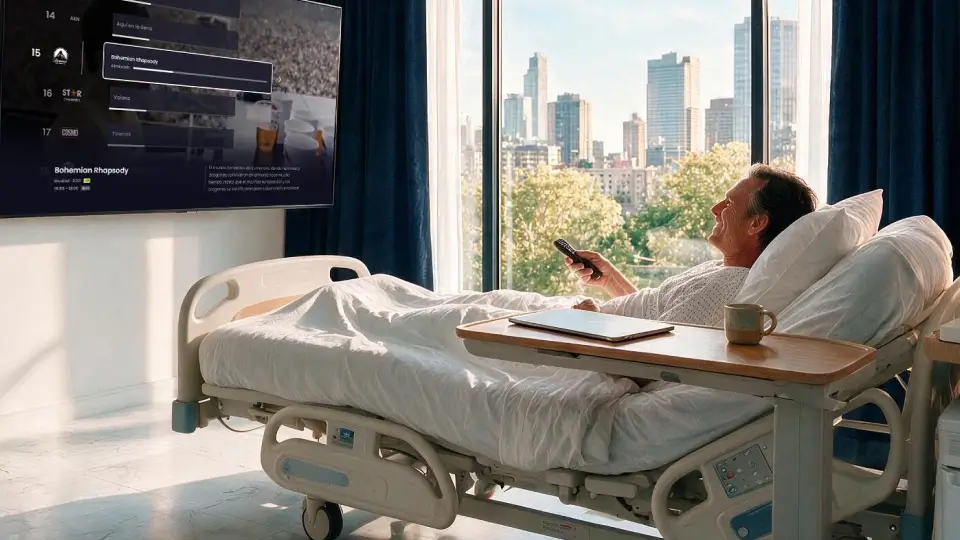
A hospital room is a very different environment from a hotel room, but both are experiencing a shift in how technology contributes to the experience of the people using them. Patients may spend several days or weeks in a healthcare facility, often in unfamiliar surroundings, where access to information, communication, and familiar entertainment can be particularly important.
The television has traditionally provided a connection to the outside world, but conventional hospital TV systems increasingly fall short of the digital experiences people encounter in their everyday lives. Patients routinely use smartphones, tablets, and streaming platforms, and these habits do not disappear when they enter a healthcare facility.
A modern patient entertainment platform can bring together live television, on demand content, streaming applications, and intuitive interfaces within a managed environment designed specifically for healthcare. Depending on the facility’s requirements, the experience can also incorporate multilingual information, hospital announcements, educational content, and other nonclinical communications that help patients navigate their stay.
The opportunity lies in providing flexible technology that accommodates different patient populations and healthcare environments while allowing facilities to modernize their patient experience over time, rather than requiring every organization to undertake a complete technology transformation at once.
From patient entertainment to patient engagement
The distinction between entertainment and engagement is particularly important in healthcare, where the patient experience encompasses far more than clinical treatment alone. Hospitals are increasingly considering how communication, information accessibility, and the physical environment contribute to the experience of receiving care.
In this context, a professionally managed TV platform can provide a complementary channel for delivering information and content that patients can access directly from their rooms. Healthcare facilities may use digital screens to communicate practical information about hospital services, visiting arrangements, meal schedules, and available amenities, while multilingual content and accessible interfaces can help accommodate patients with different needs.
Research supports the broader importance of these initiatives. Deloitte’s healthcare research has identified patient experience and engagement among the principal outcomes healthcare organizations seek to achieve through digital transformation, with 92% of respondents in its digital transformation research identifying better consumer satisfaction and engagement as a leading objective.
The television should not be viewed as a substitute for direct communication between healthcare professionals and patients, or as a replacement for clinical information systems. Rather, it can complement those systems by providing an accessible interface for entertainment, general information, and nonclinical communication, helping healthcare providers create a more connected patient environment without adding unnecessary complexity to clinical workflows.

An opportunity extending beyond hospitals
While hospitals represent an important part of this market, the opportunity extends across a broader range of healthcare facilities, including rehabilitation centers, long term care facilities, residential care environments, and specialized healthcare institutions.
These environments have different operational requirements, but many share a need for reliable connectivity, accessible information, and digital services that support the people using their facilities. In rehabilitation and long term care, for example, patients and residents may spend extended periods in their rooms, making access to entertainment, communication, and relevant information an important consideration in the overall environment.
For telecom operators, this creates opportunities to address a wider range of requirements within existing healthcare relationships while developing new commercial opportunities across adjacent facilities. The key is to recognize that healthcare is not a single homogeneous market, and that technology propositions must be adapted to the specific needs of each environment.
Why healthcare matters for telecom operators
The commercial rationale for entering healthcare is closely connected to the broader transformation taking place across telecommunications. As operators seek to diversify beyond traditional connectivity, managed services offer a way to generate additional value from established infrastructure, technical expertise, and customer relationships.
Healthcare provides a particularly relevant example because the underlying technology requirements overlap with capabilities that telecom operators already possess. Hospitals and healthcare facilities need reliable networks, secure infrastructure, device connectivity, monitoring, and technical support. Many operators already provide some combination of these services, creating a foundation for additional managed technology offerings.
Adding managed TV and video services can extend existing B2B relationships while creating opportunities for recurring service revenue through platform operations, content distribution, device management, monitoring, maintenance, and ongoing technical support.
There is also a strategic benefit in becoming a more comprehensive technology partner. An operator that already provides connectivity and managed infrastructure may be able to strengthen its relationship with a healthcare organization by addressing additional requirements within the same commercial relationship, without attempting to replace specialist healthcare technology providers or take responsibility for clinical systems outside its expertise.
The operational challenge behind healthcare TV
Delivering TV and video services in healthcare environments presents a number of technical and operational challenges that distinguish this market from conventional consumer television. Healthcare facilities often operate complex infrastructures developed over many years, incorporating different generations of network equipment, displays, applications, and third party systems.
Device management is another important consideration. A hospital may have hundreds or thousands of endpoints distributed across patient rooms and other locations, each requiring reliable operation, maintenance, and lifecycle management. Security and privacy are equally important, particularly where TV services coexist with clinical systems or operate within environments subject to strict data protection requirements.
Accessibility also needs to be considered from the outset, as interfaces and content must accommodate patients with different physical, sensory, linguistic, and cognitive needs. These requirements make the underlying technology architecture particularly important, since healthcare providers need solutions that can accommodate different environments while maintaining reliable operations.
For telecom operators, entering healthcare with a fragmented collection of technologies and vendors can quickly undermine the commercial rationale for offering managed services. A scalable proposition therefore requires a platform capable of absorbing much of that complexity.
👉 Ready to explore healthcare as your next B2B opportunity?
Discover how AgileTV helps telecos bring TV services to hospitals and healthcare facilities through a fully managed platform.
A unified approach to managed TV services
Rather than requiring operators to assemble separate systems for content delivery, applications, device management, monitoring, and support, a unified platform can bring these capabilities together within a common operational environment.
For healthcare facilities, this can provide a more consistent approach to delivering entertainment and nonclinical digital information across patient rooms and other areas, while accommodating different deployment requirements and existing infrastructure. For operators, it can reduce the need to build separate technology stacks and operational teams for every healthcare customer, making it easier to develop a repeatable managed service that can be deployed across multiple facilities.
At AgileTV, the focus is on providing telecom operators with the technology and operational foundation required to extend their TV business into healthcare, while allowing them to maintain their own commercial relationships with hospitals and other healthcare organizations.
Through its cloud native TV platform, AgileTV brings together end to end TV delivery, applications, device management, content protection, CDN orchestration, monitoring, and operational support. Professional services can also support deployment, integration, migration, and lifecycle management, helping operators address the requirements of different healthcare environments without having to develop every capability internally.
The objective is to give operators a practical foundation for offering managed TV services to healthcare customers, while allowing healthcare facilities to benefit from modern entertainment and information experiences supported by reliable technology and professional operations.
Expanding the role of telecom in healthcare
The growing importance of digital technology in healthcare is changing the requirements of the environments in which care is delivered. Hospitals and other healthcare facilities are investing in connected infrastructure, patient engagement tools, and digital services that can contribute to a more accessible and connected patient experience.
For telecom operators, this creates an opportunity to participate in that transformation by building on the infrastructure and expertise they already possess. TV and video may not be the first technologies associated with healthcare digitalization, but their role within patient environments is becoming increasingly relevant as entertainment, communication, and access to information converge within connected facilities.
The opportunity is not to redefine the role of healthcare providers or introduce unnecessary technology into clinical environments. It is to support healthcare organizations with reliable, professionally managed video services that complement their broader digital strategies while creating additional value from existing telecom capabilities.
Together with hospitality, healthcare demonstrates how managed TV and video can extend beyond the traditional consumer market into environments where digital experiences are becoming an increasingly important part of everyday operations.
For AgileTV, the focus is on helping operators make that transition through a managed TV platform that brings technology and operations together, allowing them to expand into new B2B markets while keeping complexity manageable.
The next stage of telecom growth will depend in part on how effectively operators can translate their existing capabilities into services that address the needs of other industries. Healthcare is one such opportunity, and the potential extends well beyond the hospital room.


