Quality Assurance in the streaming world has never been more critical or more complex.
As platforms expand across devices, regions and user expectations, QA teams are under constant pressure to deliver faster, cover more scenarios and ensure flawless experiences at scale. The challenge is that traditional QA processes were not designed for this level of complexity.
Manual test case creation, inconsistent bug triage, fragmented tools and limited visibility across operations are no longer just inefficiencies. They have become a real barrier to growth.
A shift bigger than automation
AI in QA isn’t just about speeding things up. It’s about fundamentally rethinking how QA operates.
We’re seeing the emergence of:
- Intelligent agents that generate test cases in minutes.
- Automated triage systems that eliminate alert fatigue.
- Unified QA hubs that bring visibility, control, and consistency.
- Multi-agent ecosystems that continuously learn and improve.
But here’s the catch: AI alone isn’t enough.
Without structured data, standardized processes, and a clear operational foundation, even the most advanced AI systems fall short. The real transformation happens when automation is built on top of a solid QA framework and when teams evolve alongside the technology.
From Execution to Orchestration
One of the most powerful shifts happening right now is not technological. It’s human.
QA teams are moving away from repetitive execution and stepping into a new role: orchestrating intelligent systems.
Instead of asking:
“How do we process this ticket?”
They’re asking:
“What outcome are we trying to achieve?”
This shift unlocks:
- Faster response times (cut by up to 60%).
- Higher-quality outputs with consistent standards.
- Scalable operations without proportional team growth.
- More time spent on strategy, not repetition.
It’s a transition from doing QA to managing how QA gets done.
What Does This Look Like in Practice?
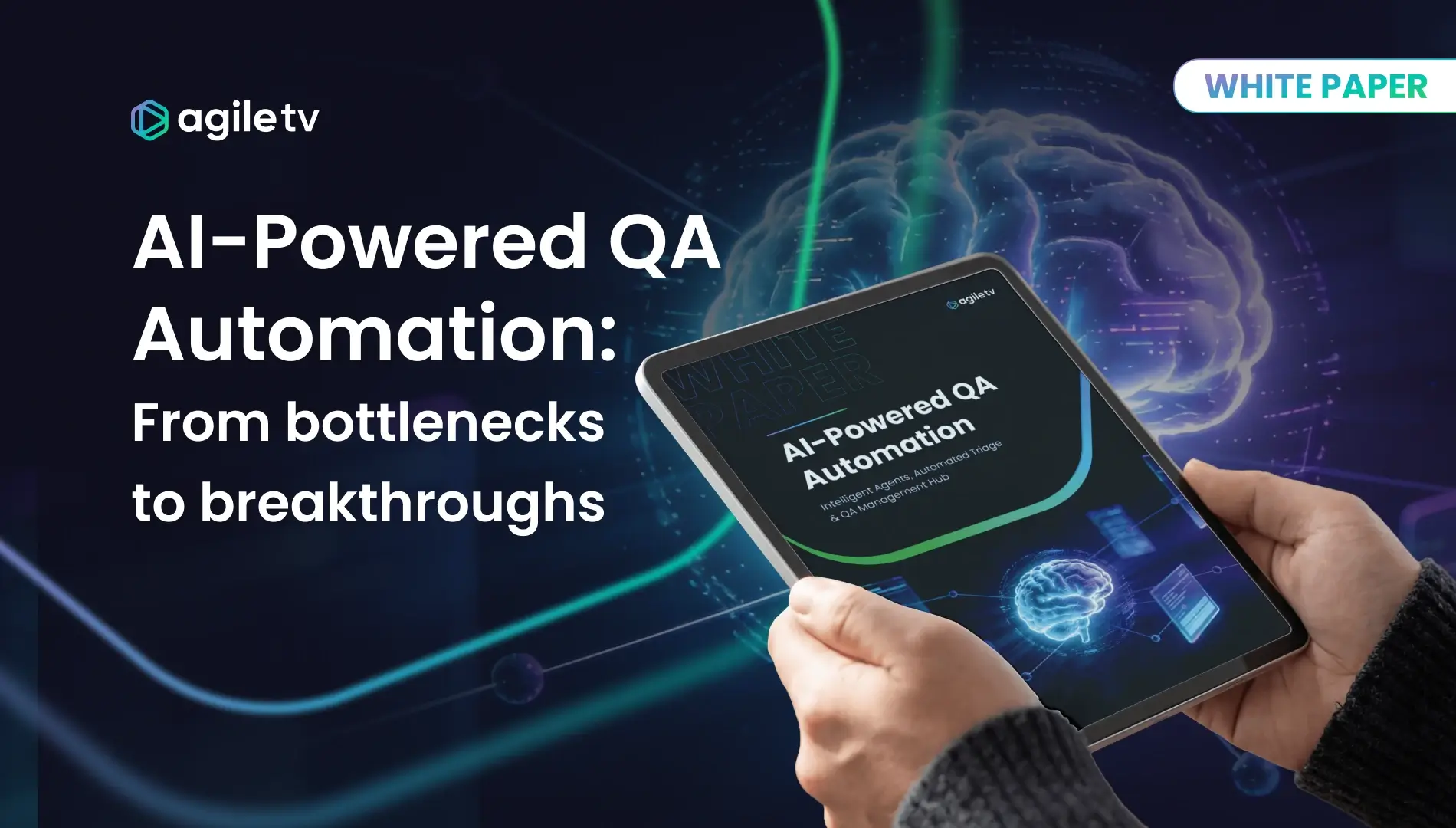
In our latest white paper, we break down how this transformation comes to life through a complete AI-powered QA ecosystem, including:
- An AI Test Case Generation Agent that turns user stories into fully structured test cases in minutes.
- An Automated Bug Triage Agent that classifies severity, detects gaps, and removes manual overhead.
- A QA Management Hub that centralizes operations, reporting, and decision-making.
- A multi-agent system where each component continuously learns from the others.
More importantly, we explore how these elements work together, not as isolated tools, but as a coordinated system designed for scale, consistency and continuous improvement.